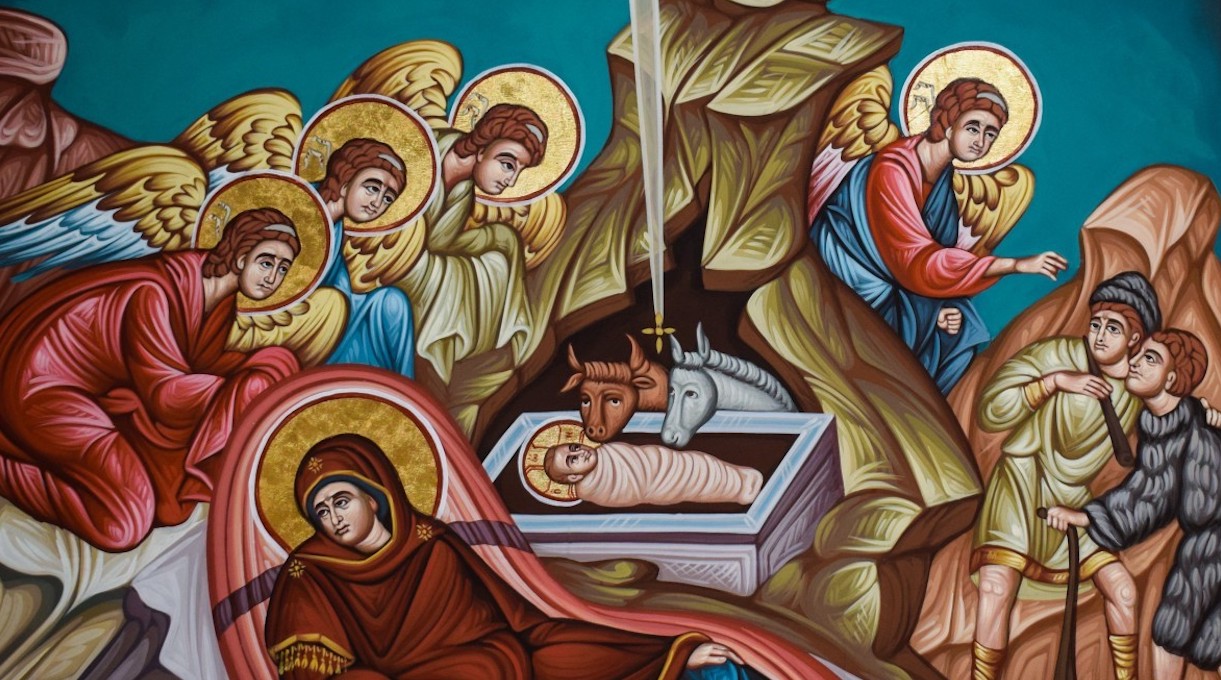
IMAGINE YOU’RE IN THE AUDIENCE AT A CHRISTMAS PAGEANT and the oh-so-familiar story is unfolding before you. It’s nighttime in Bethlehem, where a wondrous star hangs overhead. Angels watch over the birth. Because there was no room at the inn, the baby Jesus lies in a manger, in the stable, under the loving gaze of Joseph and Mary while shepherds and three “wise men” (magi) gather around.
Actually, what you see in a Christmas pageant is a mash up of two almost completely independent biblical narratives. In fact, the nativity stories in the gospels of Luke and Matthew only share the most basic narrative elements: Joseph and his fiancée Mary are in Bethlehem, where she gives birth to Jesus (out of wedlock).
Everything in the pageant story comes from the Gospel of Luke, except the star and the magi, which come from Matthew. Yet, each narrative separately (and both together) tells an archetypal story of the birth of a divine child.
Most of what we know as the Christmas story comes from Luke (1:5-2:52). The angel Gabriel, a messenger from God, tells Mary, a virgin in Nazareth, that “the power of the Most High will overshadow” her, and she will give birth to Jesus, who “will be called the Son of God” (Lk. 1:35). Mary praises God in a prayer we now know as “The Magnificat” (1:46-56). A Roman census requires Joseph and Mary to travel to Bethlehem, the City of David, to be registered (2:1-5). There, Mary gives birth and lays the baby in a manger (2:6-7). Meanwhile, an angel appears to shepherds in the fields and announces the birth of the Messiah, accompanied by a choir of angels (2:8-14). Then the shepherds go to Bethlehem, and find the child in the manger (2:15-20).
Consider all that Luke’s story gives us. The angelic visits tell us God is at work in a miraculous way in the birth of Jesus. When Gabriel visits Mary, the angel makes it clear that her virginity will not be an impossible obstacle for God and the Holy Spirit. According to Luke, Joseph and Mary complete all the rituals required by Jewish law to sanctify the birth of a son (Lk. 2:21-24, 39), demonstrating that they are observant Jews and true Israelites. Jesus, then, grows “strong, filled with wisdom” (2:40, 52). All the active characters in the unfolding drama are favored by God, and all the prophetic speeches proclaim Jesus to be a universal redeemer. Indeed, as one of Luke’s angels tells the shepherds, the birth of Jesus is “good news of great joy for all people” (2:10).
Luke’s story identifies the baby Jesus explicitly as a divine child, but also loads the narrative with symbols that point unmistakably to the child’s special nature. There are heavenly angels, a miraculous impregnation, and a birth in the city of David, who was Israel’s greatest king. Luke stands the birth narrative of a royal child on its head, however. Even though the child is identified as a king, a savior, and a son of God, he is also born in a stable, laid in a manger, and attended only by shepherds. As Mary says in her prayer, the lowly are being lifted up and the hungry filled with good things (Lk. 1:52-53).
Matthew’s much simpler version of the nativity story (Mt. 1:18-25, plus all of Ch. 2 about King Herod and the Magi) is noticeably darker than Luke’s version, but this darkness is entirely in line with the archetypal pattern for the birth of a divine child. In Matthew, the birth of Jesus is accompanied not only by a heavenly sign in the form of a special star, but also by the visit of “wise men from the East” who come from afar to pay homage to the newborn king (Mt. 2:1-2). The murderous reaction of King Herod to the advent of a new king in the kingdom, the so-called slaughter of the innocents that drives the holy family into exile (2:13-18), is a form of the archetypal adversity that greets the extraordinary birth of a divine child. King Herod, therefore, brings unimaginable violence and tragedy into what would otherwise be a gloriously hopeful story.
Luke’s tale, on the other hand, is so entirely full of light and joyous celebration that its brightness fills the whole world, leaving no hint of darkness. This burst of light makes the Christmas story entirely appropriate for a tradition that has come to be celebrated at the time of the winter solstice, when the diminishing days of autumn give way, the sun is born anew, and the light begins to push back the darkness.
C.G. Jung describes the archetypal image of the divine child as “a personification of vital forces” from the collective unconscious, an image representing the natural drive to realize oneself fully (“The Psychology of the Child Archetype” in The Archetypes and the Collective Unconscious, p. 170, ¶ 289). In other words, the divine child is an image of the Self that always points to the future — and especially to the potential for achieving wholeness.
Thank you for reading my blog. If you enjoyed this post or found it insightful, please share it with your friends. And feel free to invite them to follow the blog, too. Oh, and while you’re at it, why not check out my book, Moonlight Shines in the Darkness, a Jungian study of Jesus and the feminine in the Gospel of John.
 Soul Spirit Wisdom