THE MUSES BROUGHT PAUL McCARTNEY A MAGICAL BIT OF ARCHETYPAL INSPIRATION to get him started on the song “Let It Be” — (sing along with me now) “When I find myself in times of trouble, Mother Mary comes to me …”
The image evokes not only millennia of Marian veneration, but also our collective affection for and attraction to a beloved figure at the heart of Christmas. I think we have to thank Luke for this compelling image (whoever the author of the Gospel actually may have been).
While the gospels of Matthew and Luke both tell us about Mary giving birth to Jesus under the protective eye of her fiancé Joseph (who was not the child’s father), the two stories are quite different. Where Matthew has magi following a star, Luke has angels coming to shepherds. Matthew focuses on the murderous tyranny of King Herod, but Luke highlights the humility and devotion of Mary as she accepts her role in God’s plan.
Of course, both stories are imaginative elaborations on the facts of the birth, but that in no way diminishes their symbolic, psychological and spiritual power. To the contrary. Only the imagination can recognize the archetypal depths of meaning and tease them out of apparently mundane facts.
The nativity story in Luke contains a constellation of powerful archetypal images of the self. Two of the images reveal the dynamics at play in psychological and spiritual realization: sacred marriage and incarnation. The other images in the constellation are the central characters in the unfolding archetypal drama: the mother, the father, and the divine child. Let’s reflect on two of those images: the sacred marriage and the divine child.
The sacred marriage (which Jung discusses using the scholar’s Greek, hieros gamos) has been a significant component of human spirituality since the misty origins of our collective religious imagination. Mythologists believe it was a once a naïvely magical ritual performed by a king and his queen to assure the fertility of the fields. It eventually developed into a favorite metaphor used by Western mystics to describe the state of union with God. (See, for example, the writings of the 16th century Spanish mystics John of the Cross and Teresa of Avila).
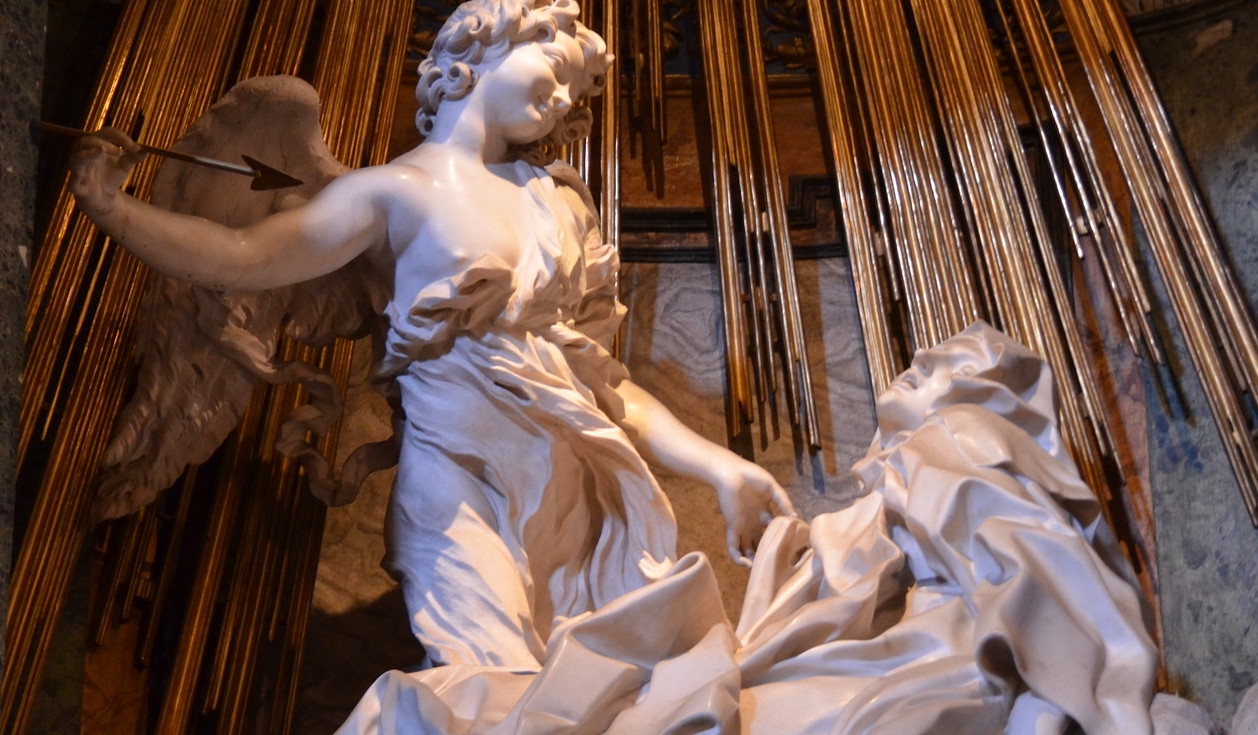
Luke’s nativity story plays with the marriage image in a twofold manner. On the one hand, the story preserves the tradition of Mary’s impending marriage to the oh-so human Joseph. On the other hand, it focuses our attention on an entirely new understanding of the sacred marriage by presenting a union between Mary, who is in no way a queen, and God, who is so much more than a king. Their “marriage” isn’t mentioned explicitly, but is implied unmistakably by her impregnation (a scene that Bernini captured under the guise of sculpting the ecstasy of Saint Teresa).
As with so much of Christian literature, the Gospel of Luke more or less turns timeless tradition on its head. The sacred marriage is no longer a ritual imitation of the gods that’s reserved for the pinnacle of elite power (think of the pharaoh and his queen imitating the marriage of Osiris and Isis in ancient Egypt). Now, it represents the transcendent God manifesting its divine immanence by uniting with humanity. It’s the conception of the Incarnation, an archetypal symbol of the self beginning to inch out from the depths of the unconscious toward consciousness. For unto us a child is born … which I’ll take up in next week’s post.
Thank you for reading my blog. If you enjoyed this post or found it insightful, please share it with your friends. And feel free to invite them to follow the blog, too. Oh, and while you’re at it, why not check out my book, Moonlight Shines in the Darkness, a Jungian study of Jesus and the feminine in the Gospel of John.
 Soul Spirit Wisdom