
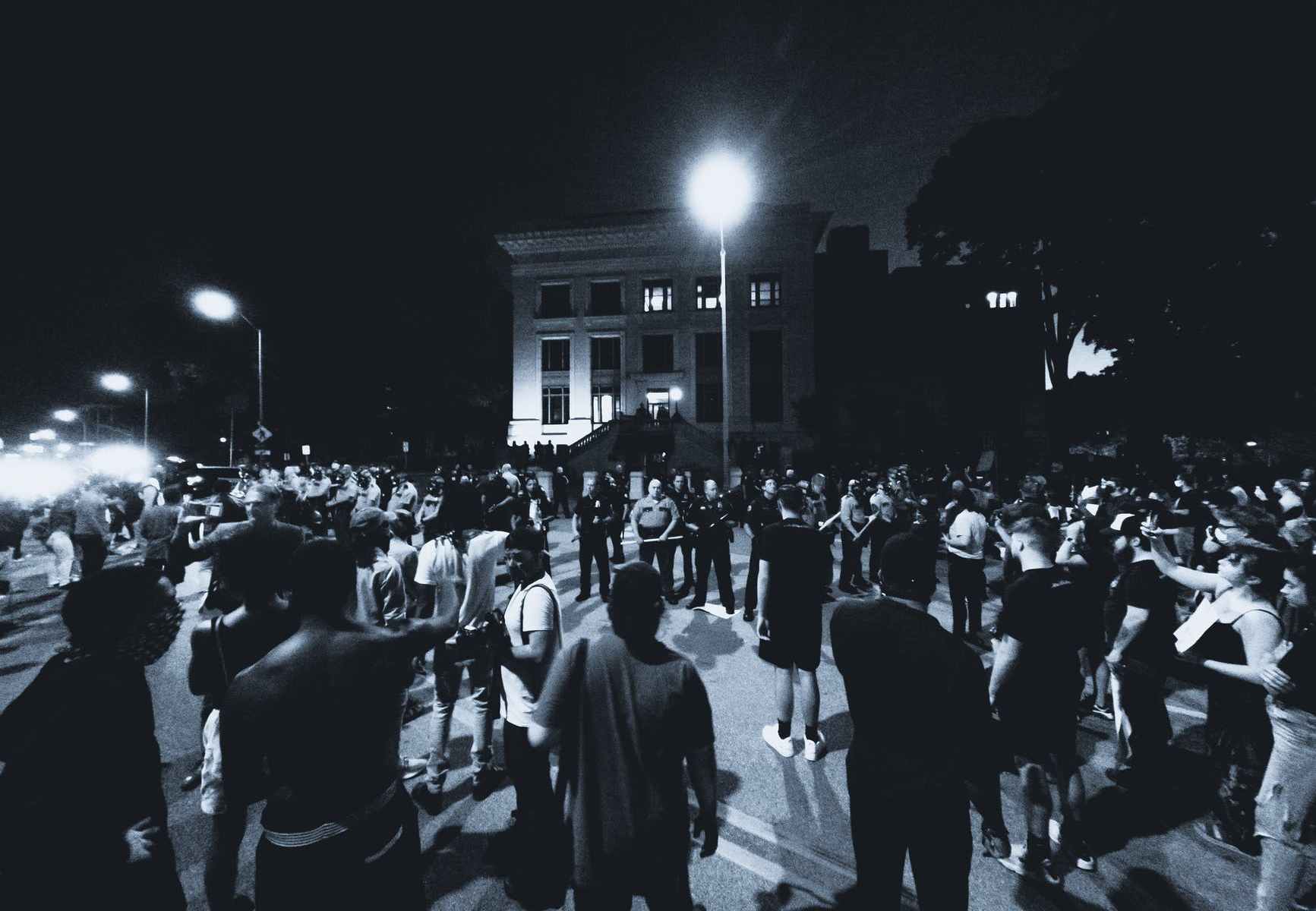
EVERY DAY, AGAIN AND AGAIN, THE NEWS SHOWS US HOW DIVIDED WE ARE and how hostile some of us have become toward the others of us who see things differently. What’s going on? How did we become so uncivil toward one another?
Denial. If you understand the mechanisms and effects of a collective denial of the shadow, you’ve gone a long way toward an answer to both of those questions. Denying our collective “darkness” creates both a delusion of “greatness” and a dangerously “neurotic” split in our national psyche. We’re living in a neurotic society, suffering through a collective shadow sickness.
Let’s not get hung up on the thought that what hides in our shadow is evil. Rather, let’s put judgment aside and try instead to look at the facts objectively. Powerfully emotional reactions have led us into our state of denial. When we see something about ourselves that we don’t like, our corporate ego naturally defends its self-image by asserting that the unpleasant something just can’t be. Someone else may have been like that, someone else may be like that, but we aren’t — not really.
If you’re willing to be honest in looking at the facts of history and the patterns of current events in the white-European culture that’s dominant in America, you’ll recognize that the dynamics of denial are especially present in our cultural attitudes toward race. Consider the following historical facts.
Europeans discovered a “new world,” which they thought of as empty and free for the taking. In fact, this world was inhabited by countless native people. The inevitable encounter between European immigrants and native inhabitants soon led to centuries of genocide by the Europeans against the natives. It’s not that every individual settler engaged in genocide, but in the clash of cultures the Europeans acted collectively in ways that all but destroyed every native nation in the land. Some might call that the march of progress, but we must see how progress marched on a road that was cut through the “wilderness” by genocide.
Consider also the history and continuing repercussions of African slavery in America. The horrors of the slave trade and of life as a slave are well known. The devaluation, the dehumanization, of Africans in the eyes of Europeans clearly was a precondition for the practice from the very beginning, and continued to fuel post-emancipation prejudice, segregation, and discrimination. It still manifests, not only in overt white supremacy, but also in systemic forms of racism that sometimes seem less obvious because no identifiable individuals are consciously responsible for the behaviors that routinely leave one group of people at a disadvantage, while consistently advantaging another. Because the systemic discrimination primarily cuts along racial lines, individual economic disadvantages seem to be more symptoms than causes.
Native genocide, slavery and racial discrimination do not make up the whole of our cultural darkness, but seen together they are enough to suggest that racism, in fact, may be America’s “original sin.” It’s the fear of the Other, of the alien, of the stranger, of the unknown that gives our collective shadow its foreboding, menacing emotional tone.
Our fear, mixed with a touch of unconscious shame, prompts us to deny and repress our shadow (both individually and collectively). The denial affirms the ego’s delusion of innocence and greatness, which then opens the door for lies to enter disguised as “irrefutable truth.” Still, the dark realities push for recognition. The only outlet available to them, however, is projection. Only the others are “dark.” We are “all brightness and light.” In the grip of these narcissistic projections, we are convinced the others are the problem — which must to be overcome, by whatever means necessary — and society splits into opposing camps.
The way out of this destructive morass leads to greater consciousness. It requires us to break through the limitations of either-or (us-or-them) thinking and adopt the more holistic and expansive both-and (us-and-them) stance. Difference doesn’t have to be threatening. Instead, confronting diversity can become an opportunity for growth.
Accepting our own darkness does not mean denying the reality of our light. The darkness and the light, together, make us whole. It’s a “secret” the Daoist sages assimilated millennia ago in the form of the tai chi — that yin-yang circle in which the black and white “fish” embrace each other in an eternal dance of becoming, and each nurtures the embryonic seed-egg of its opposite.
Thank you for reading my blog. If you enjoyed this post or found it insightful, please share it with your friends. And feel free to invite them to follow the blog, too. Oh, and while you’re at it, why not check out my book, Moonlight Shines in the Darkness, a Jungian study of Jesus and the feminine in the Gospel of John.
 Soul Spirit Wisdom