
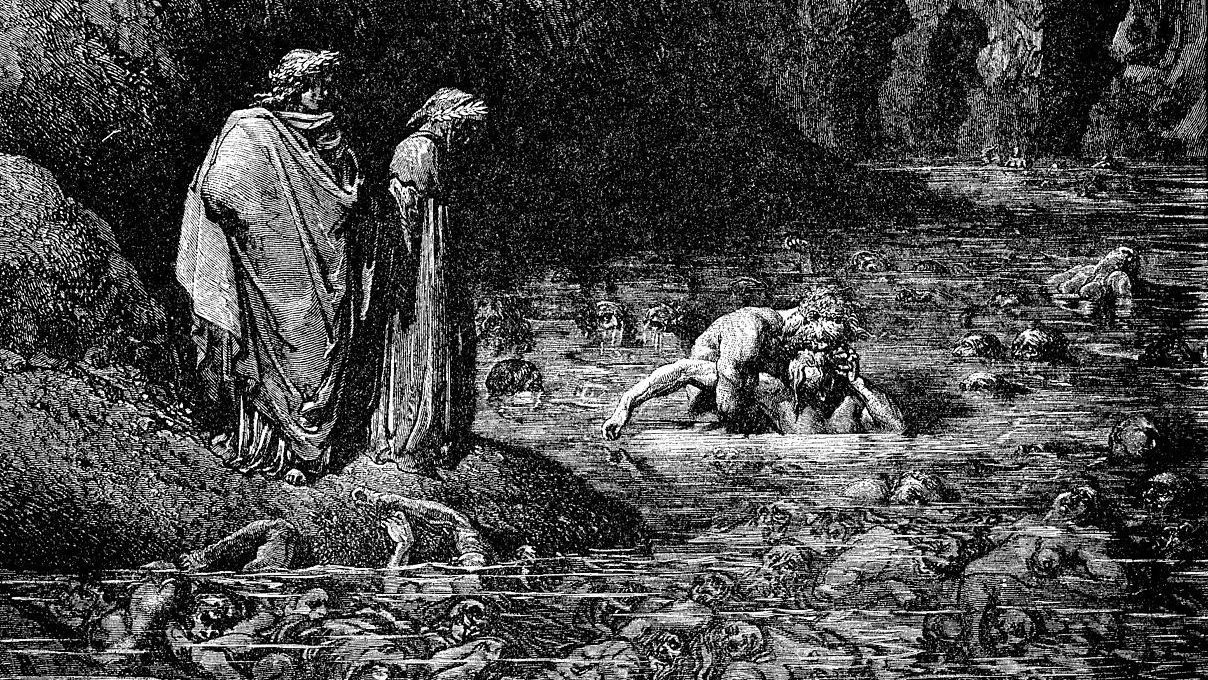
IMAGINE WHAT IT MIGHT BE LIKE TO DIE AND DISCOVER YOU’VE BEEN SENT TO HELL. Never mind the fact that in the cosmos, as we now understand it to be, there’s no “below” for hell (and no “above” for heaven). In the Western tradition, hell is believed to be an infernal, fiery place for eternal, punishing torture and torment from which there is no escape — ever.
While the descriptions of the tortures and torments have varied in detail through the millennia, they generally agree that the punishments of hell are agents of justice that give evil “sinners” their due. The type of justice envisioned is always retributive, and the punishments often seem to be nothing more than divine acts of vengeance.
Sometimes the imagined punishments in hell follow the ancient lex talionis (the law of retaliation: an eye for an eye). A blasphemer, for example, is said to be condemned to hang by his tongue over an eternal fire, while women who plaited their hair to seduce men are hung by their necks and hair.
Other punishments appear to be straightforward revenge fantasies. Self-righteous ancient authors take obvious glee in describing how the wicked wealthy and powerful who oppress the righteous poor and marginalized during their lives have the tables turned and get their comeuppance in their afterlife. The wealthy and well satisfied of the world find themselves in hell, destitute and deprived. Tyrants who condemned believers to die in flames find themselves burning, forever. Those who committed infanticide find their dead children watching with delight as the parents are tormented.
These are just a few examples, but they make the point. The suffering of those condemned to “punishment” is not in the least redemptive, and the traditional descriptions of the tortures of hell can hardly conceal their authors’ schadenfreude.
This is not at all surprising, when you consider who was writing these accounts of the afterlife. The traditional Western understanding of heaven and hell comes mostly, though not entirely, from early Christian works composed during the first four centuries of the current era. The writers were influenced not only by earlier Platonic (Greek) philosophers and apocalyptic (Jewish) visionaries, but also by their lived experiences as a marginalized group in the Roman Empire. (For a thorough treatment of this subject, see Bart Ehrman’s Heaven and Hell: A History of the Afterlife, Simon & Schuster, 2021.)
Most of the time, early Christian communities were simply ridiculed or despised. Sometimes, however, they faced ruinous persecutions that could lead some of their church members to a gruesome and horrible death. Whether they were being ridiculed or persecuted or martyred, these early Christians were the oppressed victims of imperial domination. They were outcasts, even pariahs.
Is it any wonder that these marginalized and victimized people would have visions of another world in which their oppressors would pay for making them suffer so unjustly in this world?
Wisdom traditions stretching back to ancient Egypt promised the righteous a blessed life and suffering for the evil ones. In real life, however, the truly evil seemed always to be blessed while the righteous suffered endlessly. For the traditional promises to be fulfilled and justice to be served, there had to be an afterlife in which the outcomes experienced in this life would be reversed.
It’s pretty basic human psychology to suggest that the psyches of oppressed early Christian writers would compensate for the worldly suffering of the early Christians by offering up visions of another world in which the last would be first and the first would be last. In one sense, these visions sustained a hope for justice and confirmed an image of God as a just sovereign. Psychologically, however, the visions were fantasies of revenge against the powers of this world.
What are we to make of the fact that these ancient and essentially infantile revenge fantasies still exert so much influence today, all these centuries later? Yes, it means we’re dealing with dominating archetypal energies and images. Even so, maybe it’s time for us to grow up, to be more rational, to expand our individual and collective consciousness so that we can begin to confront and relate to these archetypal forces more creatively and more constructively.
Thank you for reading my blog. If you enjoyed this post or found it insightful, please share it with your friends. And feel free to invite them to follow the blog, too. Oh, and while you’re at it, why not check out my book, Moonlight Shines in the Darkness, a Jungian study of Jesus and the feminine in the Gospel of John.
 Soul Spirit Wisdom