
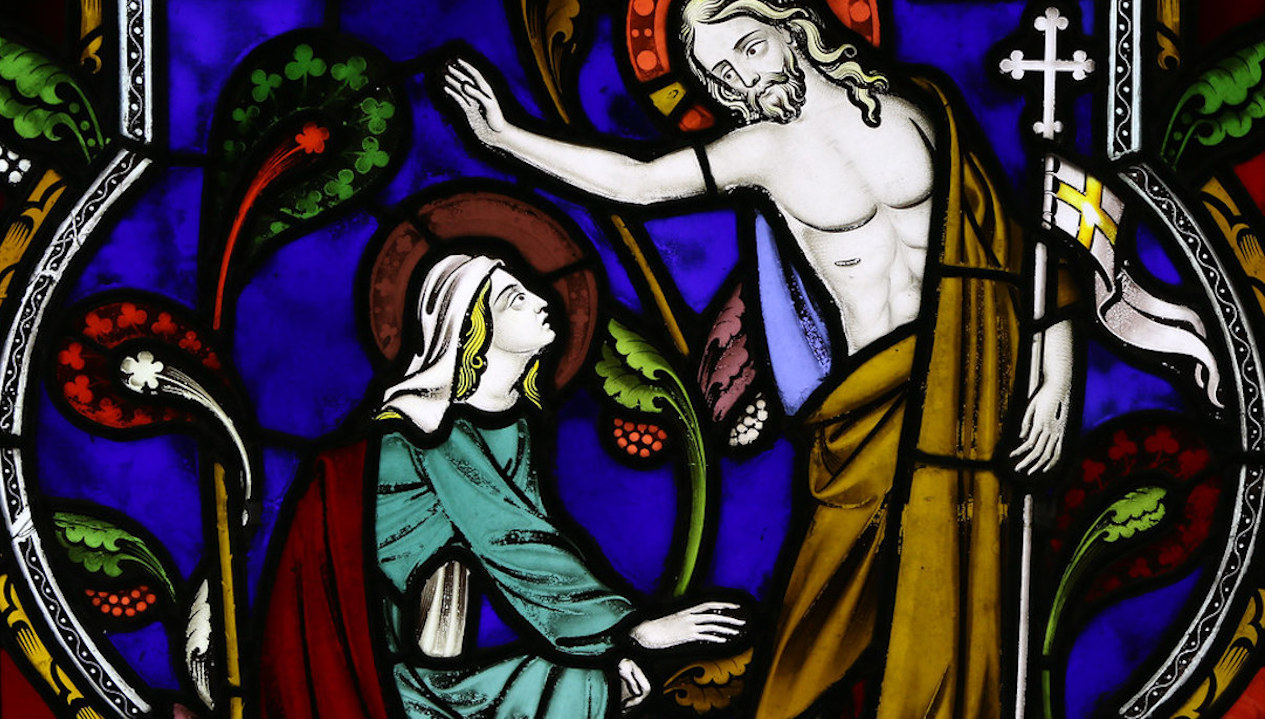
MARY MAGDALENE IS THE FIRST WITNESS TO THE RESURRECTION OF JESUS, according to the Gospel of John (20:1, 11-18), but she isn’t the “redeemed whore” of traditional Christian devotion. The Johannine portrait show us, instead, a towering woman of prophetic and spiritual power.
The tradition that makes the Magdalene a prostitute grew out of a careless conflation of two passages in the Gospel of Luke. In the first story (Lk. 7:36-50), a “sinful woman” washes the feet of Jesus with her tears. The text does not give the name of this woman, and she is not linked explicitly with Mary Magdalene.
The traditional misidentification of the sinful woman with the Magdalene came about because the Magdalene is mentioned by name, along with two other named women, in a text Luke placed immediately after the tale of the unnamed woman. Mary is named as one of the women traveling with Jesus, women “who had been healed of evil spirits and sickness” (Lk. 8:1-3). She is not said to have been a prostitute; nor is she named as the woman who washed Jesus’ feet with her tears.
Mary, however, is explicitly called “Magdalene” — not only in Luke, but also in each of the other gospels. This isn’t her “last name.” It’s an adjective identifying Magdala as Mary’s home town. Magdala, which is migdal in Hebrew, means tower, and the word is linguistically related both to a noun meaning greatness or magnificence, and to a verbal root meaning to grow up, become great, or be magnified. A tower, thus, is a symbol of spiritual growth and transformation; and Mary, the Magdalene, is a “towering” woman of greatness, magnificence, spiritual growth and transformation.
The resurrection story in the Gospel of John gives the Magdalene another meaningful name, but we have to read the original Greek text to see it. The key moment in the story comes when the resurrected Jesus, appearing to be a gardener, calls Mary by name and she recognizes who he is (Jn. 20:15-16). The standard Greek for “Mary” is “Maria.” This is the form used in this text by the Johannine narrator. The name the risen Jesus uses, however, is “Mariam,” a form used nowhere else. Christ thus links the Magdalene with Miriam, the ancient Hebrew prophet and sister of Moses.
So, just as the Gospel of John presents Jesus, the son of the Father, as the prophet like Moses, it also suggests that Mary Magdalene, through her encounter with the risen Christ, has been transformed into a prophet like the sister of Moses. Moreover, if Jesus is the new (and greater) Moses, Mary Magdalene as a new Miriam would be the sister of Christ.
This is what the symbolic images in the Johannine story say: after Easter, Jesus and Mary are brother and sister. Mary Magdalene brings the good news of the resurrection to the apostles as a sibling of the risen Jesus, and thus, the “apostle to the apostles” is a feminine face of Christ.
For more on Mary Magdalene in the Gospel of John,
please read my book: Moonlight Shines in the Darkness.
 Soul Spirit Wisdom