
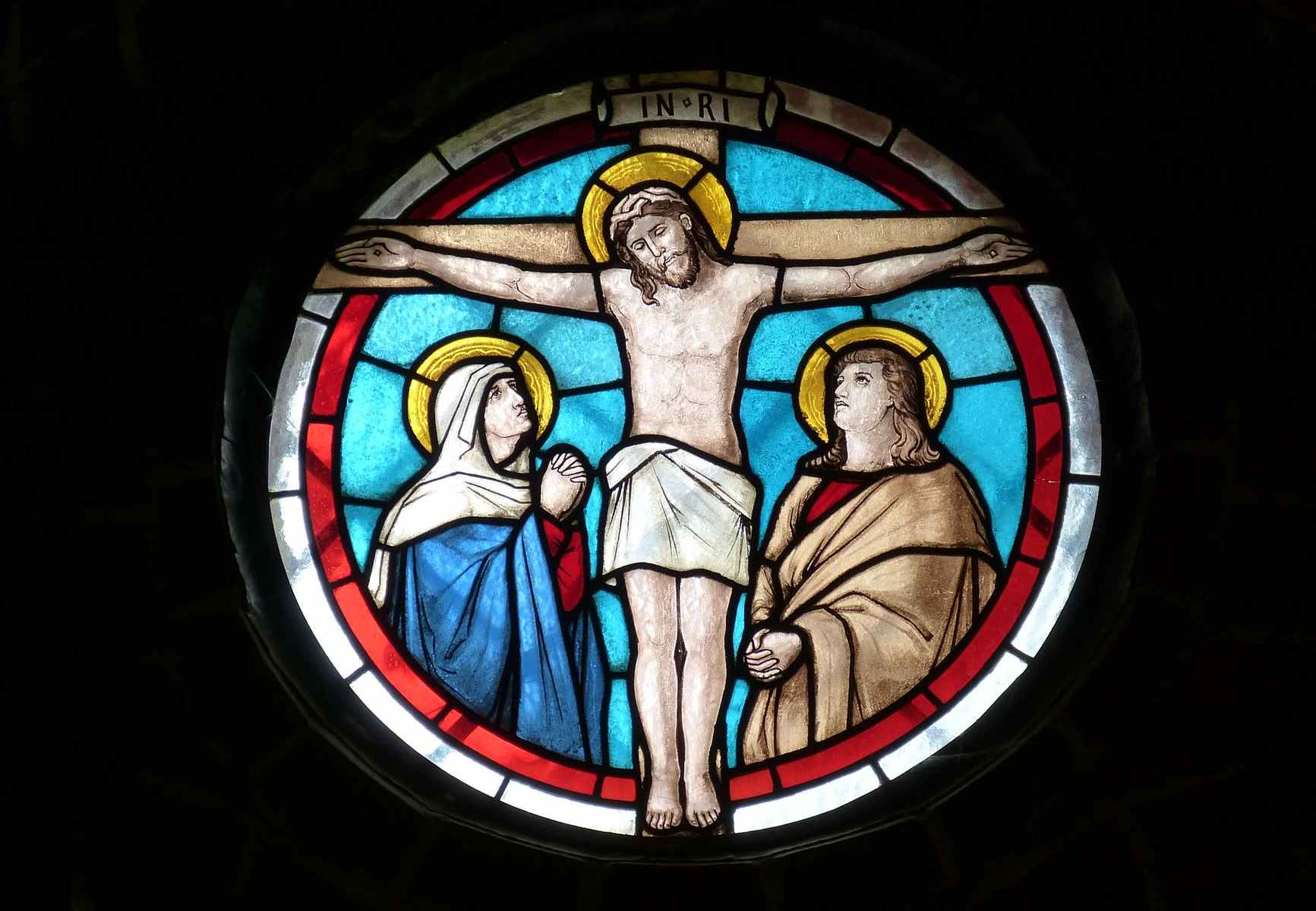
IN THE VIOLENT PUSH AND SHOVE OF OPPOSING BODIES in the U.S. Capitol on January 6th, one sign read, “JESUS SAVES.” The sign seemed profoundly out of place, in spite of its comforting promise. Among other things, the sign suggested the political cause the sign carrier was fighting for was blessed by Jesus. This statement, however, misses the mark — not because it makes Jesus politically active, but because it makes him politically violent.
Although it’s well known that death by crucifixion tells us Jesus was executed by the Romans for being a political threat to the ruling order, it has become commonplace to dismiss the implications of that fact by claiming the Romans and the Judean leaders were wrong about Jesus.
Were they? I don’t think so, and here’s why.
During the past fifty years or so, a lot of scholarly work has been devoted to an updated study of the “historical” Jesus. The scholars, asking about his human nature, have looked at the available historical sources to understand what kind of man Jesus was during his life in 1st century Galilee and Judea. Almost all the available sources, however, are biblical texts.
So, for the most part, the scholarly quest has been to understand what kind of human being would have been characterized in the various ways Jesus is characterized in the gospels. Matthew, for example, tends to cast Jesus as the new and greater Moses delivering a new and more effective Torah. While John, too, sees Jesus as the prophet like Moses, John also sees Jesus as the king like David (only not of this world), and as a powerful agent sent from heaven by the Father (that is, as Son, preexistent Word, Good Shepherd, Truth, Light, etc.).
The most fundamental ancient characterization of Jesus is captured in the Greek “fish” acronym: ICHTHYS, which in English represents “Jesus Christ of God Son Savior,” or more conventionally, “Jesus Christ, Son of God, Savior.” (The first word order is true to the Greek, and along with its lack of punctuation, preserves the ambiguity of the ancient formula.)
What we miss at a remove of two millennia from Jesus is that this formula describes Jesus in terms reserved for the Roman emperor. In other words, the simple ancient formula makes a radically subversive political statement: Jesus is the true emperor, not Augustus Caesar or any other worldly power. The fish symbol, therefore, calls us to imagine and try to realize what our lives could be, if we were to live as if God or God’s anointed one actually ruled the world.
Biblical scholar John Dominic Crossan, in his studies of the historical Jesus, which focus especially on the healing and open meal practices of Jesus, gives us an image of what the life of Jesus says our life would be, if the Father were king: an egalitarianism of shared spiritual and material resources (Crossan, Jesus: A Revolutionary Biography, p. 107). The late Marcus Borg, in his work, sees Jesus as a Jewish mystic, a charismatic healer, a wisdom teacher, and a prophet radically criticizing the injustice of the ruling “domination system” (Borg, Jesus, p. 163).
The point at which these two important scholars agree is where they see Jesus as a radical, prophetic critic opposing the injustices of the social and political domination system in which he and his people lived in 1st century Palestine.
To see what Crossan and Borg see, consider these three very familiar but largely misunderstood sayings of Jesus reported in Matthew 5:39-41. In the first, Jesus counsels turning the other cheek (v. 39). In the second, he suggests one being sued for their “tunic” should give up their “cloak” as well (v. 40). In the third, Jesus tells his listeners to walk a second mile (v. 41).
Each of these sayings spells out a creative form of active but nonviolent response to oppression. Here’s how — and always remember that Jesus and his listeners were peasants in a brutal, feudal system.
In the first scene, the one striking you on the right cheek, your social superior, uses only his ritually “clean” right hand to strike your right cheek. It is, and physically only can be, a back-handed slap meant both to assert his dominance and to humiliate you. When you turn the other cheek, inviting him to strike you on the left cheek — with his right hand again — he can do so only with an open hand (or with a fist), which would imply you are his equal.
In the court scene, a superior person is suing a pauper, probably to collect a debt, but the pauper owns only the clothes on his or her back. The tunic, which was worn against the skin, would be the pauper’s undergarment. So, gladly giving up the cloak, the outer garment, would mean the pauper would be left naked. In such an absurd scene, the pauper (the defendant), ironically, would be asserting his or her own dignity while heaping shame on the lender (the plaintiff).
In the third scene, a Roman occupier forces you to carry his pack for one mile, but there’s an imperial rule that forbids him to force you to carry it a second mile. So, when you nonetheless insist on carrying the pack a second mile, the soldier, to avoid possible punishment, would have to beg you to give his pack back to him. Thus, you would have managed to flip the script on your oppressor.
Each of these scenarios, therefore, is bit of political theater that actively challenges the ruling domination system. None is an act of quiet submission. None is an attempt at “redemptive violence” (which actually never redeems). Instead, each models a third way, a path of nonviolent resistance. (For a more thorough treatment of these scenarios, see Walter Wink, Engaging the Powers, pp. 175-82, or The Powers That Be, chap. 5.)
Let’s return, now, to the crucifixion and consider the way Jesus behaves during the final hours of his life. When the armed posse approaches to arrest him, he doesn’t allow his followers to fight. Each time he stands before a judge, Jesus doesn’t cooperate or defend himself, but remains mostly silent. When he’s nailed to the cross and raised up, his agonizing death puts the unjust cruelty of the ruling powers on full display. These are acts of nonviolent resistance to domination. This is the way of Gandhi and Martin Luther King, Jr. In other words, the self-sacrifice of Jesus shows us the way to live a more abundant life in this world. Yes, Jesus saves.
 Soul Spirit Wisdom
One Reply to “”