

BIBLICAL LITERALISM VIOLATES BIBLICAL TRUTH. Retired Episcopal bishop John Shelby Spong calls it heresy. Literal interpretations of biblical texts miss the mark because they assume most of the texts are straightforward reports of facts. In doing so, such interpretations ignore the literary genres of the texts they interpret.
Let’s consider the literary genres present in the Bible. The Gospels and Acts are devotional arguments in support of the Jesus movement, not historical biographies. The Epistles contain pastoral instructions for converts in specific situations and theological discourses, not prescriptions for all times and places. The Revelation is an allegorical vision, a type of dream, not a series of factual predictions to be decoded. The Hebrew Bible preserves the traditional lore of the Israelites and the nations of Israel and Judea, including foundational legends, devotional poetry, and social criticism.
No biblical text should be read the way we read a modern, post-Enlightenment, factual report or historical account or scientific description, because the predominant language of the Bible is metaphor and symbol. Speaking in a very broad generalization, we can say the Bible is poetry — ancient, historical poetry perhaps, but poetry nonetheless.
The poetic character of biblical texts does not at all mean they are “only” poetry, and thus, not “true.” To the contrary. When we humans give voice to our most profound truths, insights and wisdom, we tend to speak (and write) in poetry, not prose. That’s what the inspired biblical writers did. And that’s why the Bible remains a living text, the living Word of God.
Biblical texts remain alive because the symbolic language of their inspired poetry is inexhaustible. A symbol points both to something known and to something ultimately unknowable. Thus, symbols remain open to a surplus of meaning, and need to be engaged through a method of interpretation that honors the openness of symbolic expression.
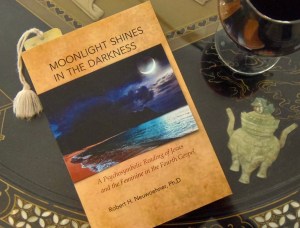
In the introduction to my book, Moonlight Shines in the Darkness: A Psychosymbolic Reading of Jesus and the Feminine in the Fourth Gospel, I outline such a method. As the book’s subtitle suggests, I call this method psychosymbolic interpretation. It adapts C. G. Jung’s method of dream interpretation for use with literary (and cinematic) texts.
Psychosymbolic interpretation is psychological because it acknowledges that texts are and must be, at least in part, products of the human psyche. The method is symbolic because it takes seriously the inexhaustible nature of symbols and provides techniques for revealing a significant portion of their surplus of meaning. It is interpretation because it attempts to “translate” the symbolic text into analytical terms, rational concepts, and practical applications.
The psychosymbolic process has three steps: reading the text, amplifying the symbols, and interpreting the amplified text. The first step is basically a literary analysis of the text that lays out the structural elements in the narrative, including its characters, settings, and plot. Its goal is to identify the key symbolic images in the text. Amplifying is a comparative process, exploring a range of historical, mythic, literary, and artistic images that are associated with the symbols in the text. Interpretation attempts to synthesize the understandings uncovered in the previous steps and “translate” the symbolic meaning of the text into a more comprehensible, and more limited, language (for example, into the psychological language of Jungian theory).
The benefits of psychosymbolic interpretation are threefold as well. It helps us approach and appreciate poetic expression on its own terms. It opens us up to the profound surplus of meaning lying “hidden” in symbolic texts. And it invites us into living engagements with living texts.
# # #
If you want to know more about how psychosymbolic interpretation can transform your relationship with the Bible — forever — please CLICK HERE, and you’ll find a link to a sample chapter of my book in which I describe the process and its theoretical foundations.
 Soul Spirit Wisdom
2 Replies to “Reading the “Secret” Language of the Word of God”